Reader,
No Will, No Authority: What to Ask Before You List an Estate Property
“Dad passed in the spring. My brother and I want to list the house next week.”
Nobody has been appointed, and the probate court hasn’t issued anything. Georgia doesn’t require court permission to list, but the brokerage engagement they’d sign says the seller has title and authority to sell. Right now, neither of them has either one.
How Often Death Puts a House on the Market
About 3.07 million people died in the U.S. in 2024 (CDC). 65% of U.S. households own their home, about 87 million homes (U.S. Census Bureau, second quarter 2026). Only 24% of Americans have a will (Caring.com, 2025), down from 33% in 2022.
Those numbers match what I’ve seen in practice. When I was with a prior firm, I asked our in-house estate planning attorney what percentage of the probate titles she worked on had wills. Her answer: about a quarter. Think about that. Those are homeowners, people with real assets to protect, and three out of four of them left no will.
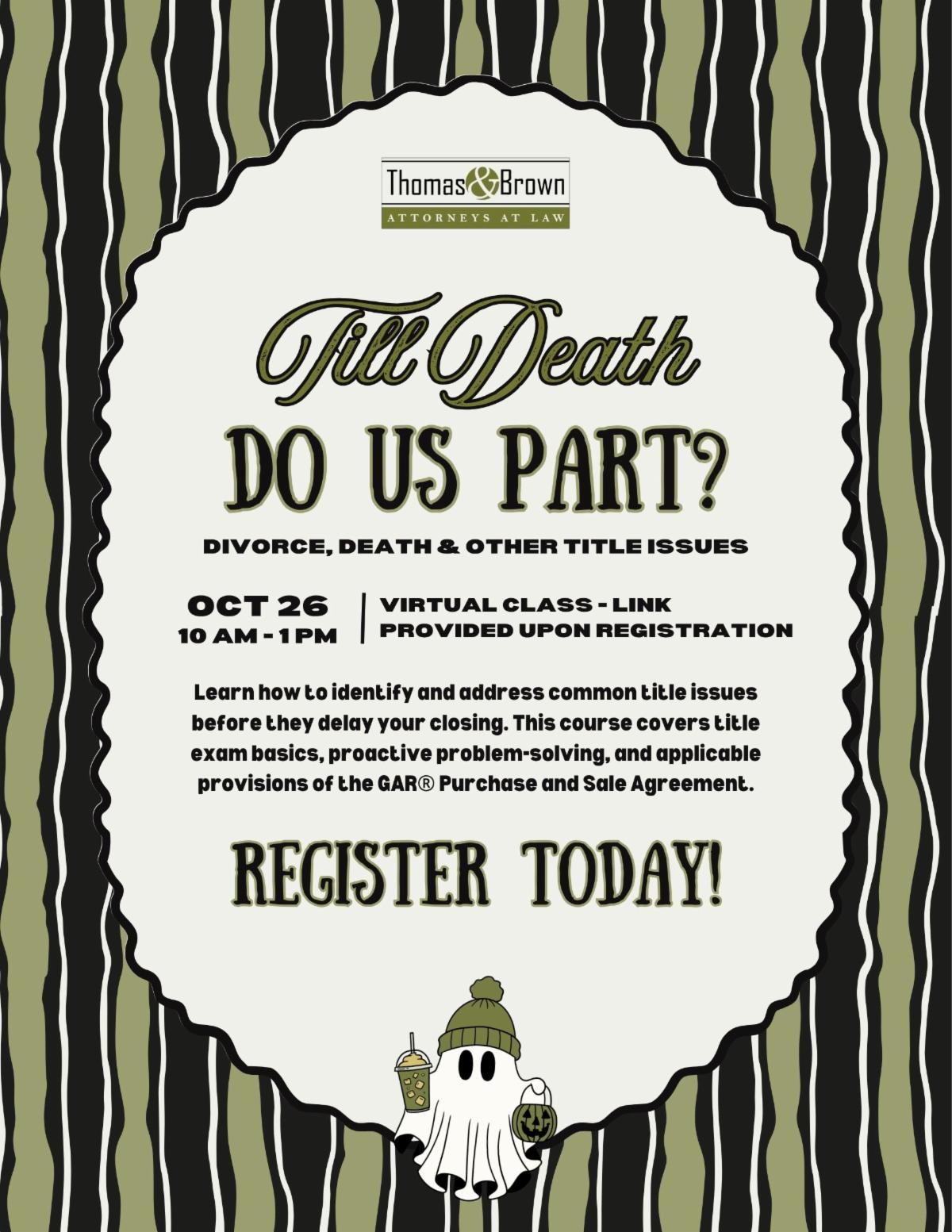
Every one of those houses needs someone with court authority to convey title before it can close. That’s October’s class, Till Death Do Us Part?: death, divorce, and who can sign.
Famous Estates With No Will
Famous people die without wills too.
• Abraham Lincoln (1865). A lawyer, and he died without a will. A court appointed Judge David Davis to administer the estate, which was split among Mary and their two surviving sons.
• Jimi Hendrix (1970, age 27). No will. Everything passed to his father under state law, and the family fought over his music and money for decades.
• Prince (2016, age 57). No will, no spouse, no children. His siblings and half-siblings became the heirs, Paisley Park was part of the estate, and it took about six years, plus a fight with the IRS over what everything was worth, to settle.
• Chadwick Boseman (2020, age 43). He married months before he died and left no will. His wife had to petition the court to be appointed administrator of an estate valued under $1 million. Estate size doesn’t change the process.
• Aretha Franklin (2018, age 76). Her family believed she died without a will until handwritten papers turned up in her home, one of them in the couch cushions. Her sons litigated over which document controlled until a 2023 jury upheld the couch-cushion version. A homemade will can create almost as much mess as no will at all.
What Happens to a Georgia House When There’s No Will
When a Georgia homeowner dies without a will, Georgia’s laws of descent and distribution (O.C.G.A. § 53-2-1) decide who inherits. A surviving spouse shares equally with the children but takes no less than one-third. With no spouse or children, it moves to parents, then siblings, and on down the line. Plenty of widows and widowers are stunned to learn the house didn’t simply become theirs.
How title was held matters as much as whether there’s a will. If the owner held title alone, or as tenants in common (the default deed), that owner’s share goes through their estate. If the deed says joint tenants with right of survivorship, using the exact survivorship language, the survivor takes the deceased owner’s share automatically, without probate, even if the will says otherwise.
When the house goes through the estate, the estate owns it, and the heirs don’t. A will doesn’t give anyone authority until it’s probated. Authority to sell comes from the probate court, through Letters Testamentary (there was a will) or Letters of Administration (there wasn’t). The person holding those Letters, the Personal Representative, is your seller.
Who inherits what is a question for the probate attorney. It’s outside your license, and estate planning and probate are outside the closing attorney’s role too. Your job is to find out who can sign and what document proves it.
Strategy 1: Ask the Probate Questions Before You Set a List Date
The probate paperwork tells you where the family is in the process and who has the power to decide. Ask for it at the first conversation, before anyone picks a list date:
• Is there a will?
• Has probate been filed? In which county, and in solemn or common form?
• Who has been appointed Personal Representative? Any co-executors? (If so, more than one person signs.)
• Is there a probate attorney? If not, refer one.
• Are any heirs minors or unable to act for themselves?
• Who is living in the property, and will they cooperate with showings and move out on time?
• Did a spouse die earlier whose estate was never probated?
• Do the heirs agree on selling?
Two of those deserve a closer look. Solemn vs. common form is the difference between a sale and a stall. Solemn form gives heirs notice and a chance to contest, and the result is binding. Common form skips the notice, which feels simpler, but heirs then have four years to object and title isn’t marketable during that time. It tends to happen when families handle probate themselves or never planned on selling.
The county matters too. Probate is filed in the county of the person’s residence, which may not be where they died or where the house is. A probate filed in another county won’t turn up on the title exam in the property’s county, so tell the closing attorney where it was filed.
Strategy 2: Get the Documents and Check the Deed at Listing
Collect these at the listing appointment, not weeks later when the closing attorney asks for them:
• The will, if there is one
• The petition to probate (it shows solemn vs. common form)
• Letters Testamentary or Letters of Administration
• Any order limiting the Personal Representative’s authority or requiring court approval
Proceeds go to the estate, not to the heirs directly, so the Personal Representative needs an estate EIN and an estate bank account. The EIN is free at IRS.gov and takes minutes. Warn them about the paid look-alike sites. Setting those up is the Personal Representative’s job; yours is making sure they know early.
Then pull the most recent deed on gsccca.org. Not the tax record, not the MLS. Every name on that deed should be signing, or you need to know why not. The classic problem: Mom is selling, but Dad died ten years ago, his name is still on the deed, the deed isn’t survivorship, and his estate was never probated. His share still belongs to an estate nobody opened. If the deed raises a question like that, ask the closing attorney to run title at listing.
Strategy 3: Protect the Deal With the Right Language and Signature
The listing. Unlike some states, Georgia has no court permission to list. The Exclusive Seller Brokerage Engagement Agreement does say the seller has title and authority to sell, and the Purchase and Sale Agreement requires Good and Marketable Title, but not until Closing. The brokerage engagement also has a Special Circumstances paragraph for anything that affects the ability to list or sell. There’s no probate box, but there is “Seller Not on Title” and “Other,” and a pending probate can go under “Other.”
That’s appropriate, and smart, only when you and the “seller” know the status of the probate and it’s well underway. Even then, unpleasant surprises are always possible. If nobody has filed anything yet, you’re listing a house on hope.
The contract. Whether you need a probate contingency depends on the facts. Get the probate attorney’s estimate for when Letters will issue, then add time for the almost inevitable delays. If Letters are expected well before closing and the contract period is long enough, you may not need one. If there’s any doubt, start with the GAR® Court Permission to Sell Contingency (SS 624) and tailor it from there.
The buyer’s side. A seller contingency protects the seller by default. If you represent the buyer, ask for something in return, starting with having the Due Diligence Period and the buyer’s other deadlines run from the date the seller gives Notice that court authority has been received. That keeps your buyer from paying for inspections and an appraisal while the estate still can’t sell.
The signature. Sign it the way title will close: in the name of the estate, by the Personal Representative, in that capacity. The signature page is the only place in the contract where the parties are named, so get it wrong and the closing attorney may run title on the wrong person.
What Good Looks Like
Special Circumstances, “Other,” in the brokerage engagement (only when the probate is filed and well underway):
Probate order granting authority to sell is pending. The contract ☐ will ☐ will not need to be contingent upon the issuance of an order from the probate court.
The contingency, tailored from the GAR® Court Permission to Sell Contingency:
This Agreement is contingent upon Seller receiving court authority to sell the Property from the probate court having jurisdiction over the estate, sufficient to convey Good and Marketable Title (the “Contingency Requirement”), on or before ________ (the “Contingency Date”), with Seller providing a copy of the court’s order or letters to Buyer as proof. If the Contingency Requirement is not satisfied on or before the Contingency Date, Seller or Buyer may terminate this Agreement by giving Notice to the other, and Earnest Money shall be refunded to Buyer.
The signature, once Letters have issued:
Jane Doe, as Executor
The Estate of John Doe
Send any probate paperwork with the contract when it goes to the closing attorney, and confirm the exact signature format with them.
Join the Live Zoom Class
Till Death Do Us Part? Divorce, Death & Other Title Issues
When: Monday, October 26, 2026, 10:00 a.m. to 1:00 p.m. Eastern
Where: Zoom
CE: 3 hours of Georgia CE (GREC Course #78070)
Cost: Free
We’ll cover who can sign when an owner dies, divorces, or acts through a trust, POA, or LLC; the probate and divorce contingencies; how to sign so the paperwork matches how title will close; and the intake questions that bring these problems out at listing instead of at the closing table.
Register here
Frequently Asked Questions
Can I list a house before probate is finished? Georgia doesn’t require court permission to list, and the contract requires Good and Marketable Title at Closing, not when it’s signed. You can note a pending probate under Special Circumstances in the brokerage engagement, but only when you and the family know where the probate stands and it’s well underway. Even then, surprises happen, so decide whether the contract needs a court permission contingency.
Does a house held with right of survivorship go through probate? Not when the first owner dies. With the correct survivorship language on the deed, the survivor takes the deceased owner’s share by operation of law. Probate comes into play when the last owner dies.
Does a seller have to disclose that the owner died? The Seller’s Property Disclosure Statement doesn’t ask, and the duty to disclose latent defects normally covers the physical property. But a filed probate is public record, and a deed showing someone who didn’t sign the contract is probably notice too. When the situation is shaky and there’s no contingency, consider disclosing anyway.
Have a probate or title situation you want a read on before you list? Reach out at cherylking@realsmartonline.com, and I’ll keep your name out of it if it turns into a future write-up.
⚠️ REALsmart Reminder
Selling a house is stressful even when it isn’t preceded by a death. The people involved in an estate sale are often overwhelmed. Agents shine when they anticipate issues and remove roadblocks before anyone hits them. Before you set a list date, ask whether there’s a will and who has been appointed, and pull the most recent deed yourself.
🔗 Read Other Articles
Stay Smart,
Cheryl Conner King
Founder & Instructor
REALsmart Real Estate School
Attorney | REALTOR® | CE Instructor
📍 Based in Georgia | Teaching Statewide